

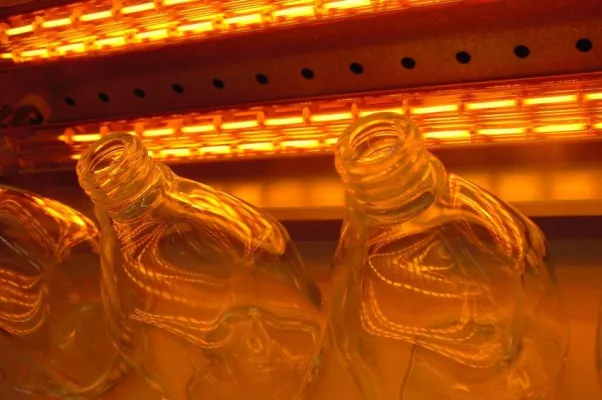
On the finishing line, that oven lamp doesn’t just add heat—it sets the rhythm. If you’re tempering, bending, or drying coatings, uneven temperature or a lagging response drags the whole line down. You start seeing bowed glass, thermal stress cracks, and takt time slipping away. We built our infrared oven lamps for the plant floor as it actually runs, where heat has to be predictable, repeatable, and fast. What matters under the hood We run short-wave infrared emitters in a quartz envelope, tuned for rapid, directional radiation with minimal convection. That gives you a uniform thermal field across the glass, so hot and cold spots that drive optical distortion and stress are kept in check. Response time is measured in seconds, not minutes, so you hit setpoints quickly and hold them steady. Output stays stable over thousands of hours, with controlled emissivity and consistent power density. In practice, that means shorter ramp-up, tighter dwell control, and profiles you can run again and again for tempering, bending, and coating drying. In glass finishing, speed and uniformity translate straight into yield and throughput. Faster ramp-up cuts cycle time on tempering lines, and bending cycles stay consistent even when you switch thicknesses. Uniform heat distribution cuts rejects caused by thermal gradients, and because infrared heating is directional, you’re not wasting energy heating air and fixtures. The lamp drops in as a module, so you can replace aging units without re-engineering the oven. Fewer tweaks, more stable quality, and lower energy per finished part. Here’s the part that bites you if you ignore it: infrared lamps are sensitive to mounting geometry and reflector alignment. Output and uniformity depend on getting the position right. Clearance and focal distance have to match the oven design, and reflectors need to stay clean and undamaged. The operating environment matters, too—high ambient temps and airflow can shift performance, so confirm your oven’s ventilation and thermal load. We provide dimensional drawings and power curves to make the swap straightforward, but field verification is what ensures the profile you need is the profile you get.